
What is an R&D Center?
Origins and Mission
In recent years, with the aim of realizing Society 5.0, demand for products and services utilizing IoT, robotics, artificial intelligence, big data, etc. has surged, and diverse values are driving the market, such as the shift in the source of competitiveness from hardware to software and platforms.
In response to these societal trends, Maruho Spring Industry aimed to shift from in-house development to open innovation, utilizing external technologies and ideas. As a partner in realizing open innovation, we have entered into an industry-academia collaboration agreement with the Graduate School of Engineering Science at Osaka University and are active in the Joint Research Chair for Computational Engineering Supporting Medical Device Development (hereinafter referred to as the Joint Research Chair).
The R&D Center was established in 2020 with the aim of promoting these activities and contributing to technological innovation in each business unit by providing technological seeds that meet the customer needs of each unit and by supporting research.
Main business
The R&D Center works with key technical personnel in each business unit to set research themes and provides support from patent and literature searches to research promotion. We have established a joint research chair within the Graduate School of Engineering Science at Osaka University. We have invited a full-time professor to serve as the chair, and we operate in an environment where we can receive research seeds from all laboratories in the Graduate School of Engineering Science. Our main work involves industry-academia collaboration activities centered on the technical consultation desks of each business unit and the joint research chair, in order to match the latest technological seeds with the customer needs of each business unit.
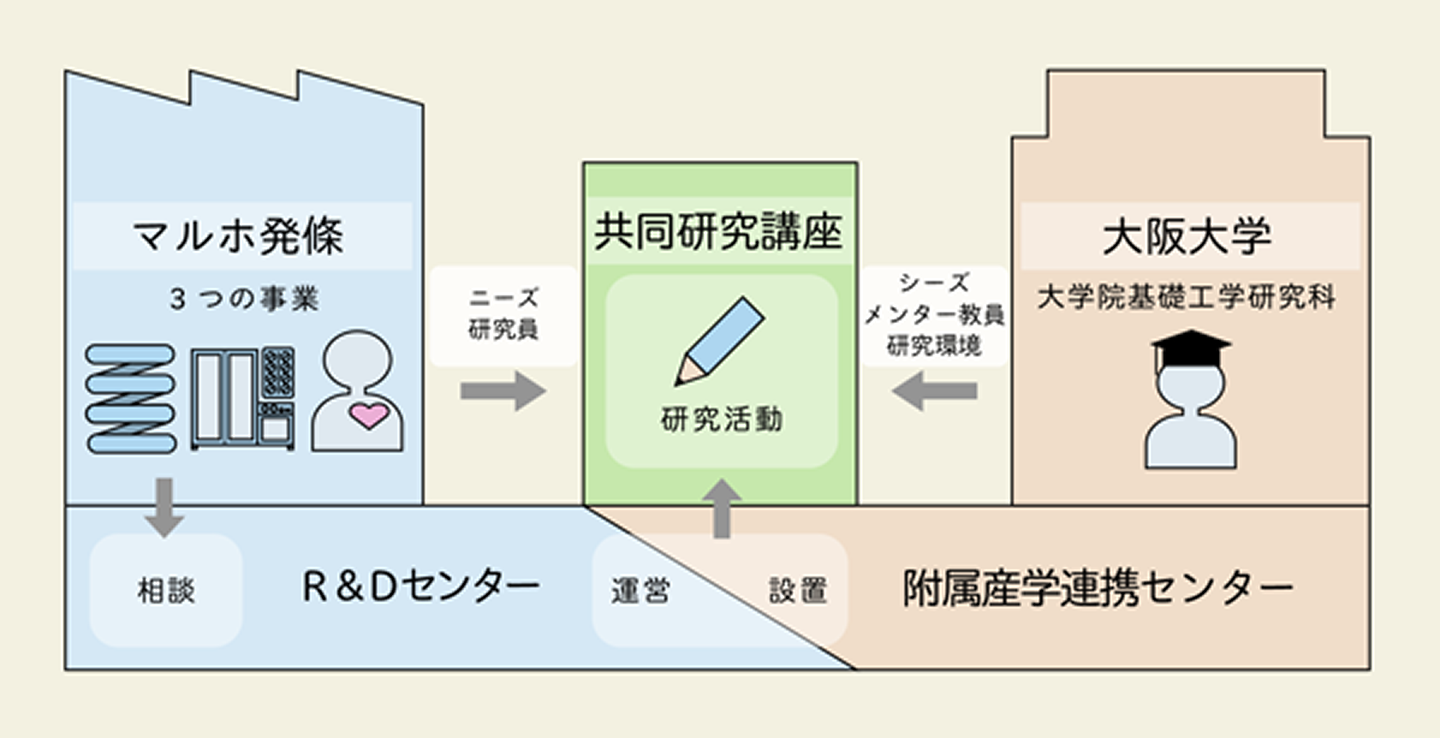
Introduction to the Joint Research Course
Our Projects
The joint research program is developing tools that enable functional analysis and design, which are difficult to perform using conventional trial-and-error methods, through simulation. This allows for a theoretical understanding of functional characteristics and reduces the time required for design. In the joint research program, Professor Kohei Murase (full-time) provides cutting-edge knowledge on simulation, and Maruho Spring Industry provides know-how from engineers in each business unit, resulting in the development of simulators that can be immediately put to use by the business units.
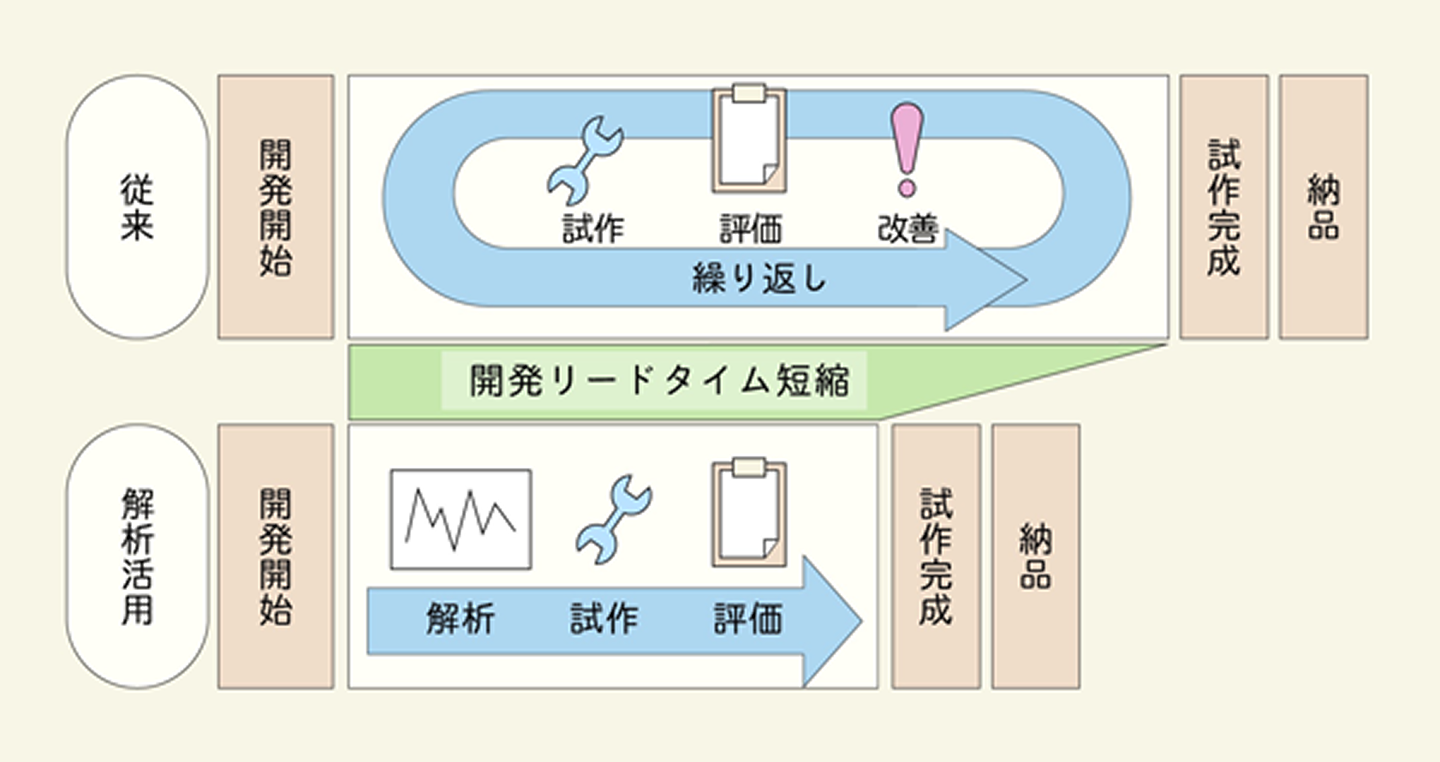
Resesarch topics
Spring Division
The connection between research and business divisions
Our spring division manufactures compression coil springs, tension coil springs, torsion springs, decorative springs, and leaf springs, which are components of mechanical elements. These springs are used in a variety of fields, including automobiles, electronic and electrical equipment, machinery, housing equipment, and medical equipment. In the automotive sector, we respond to customer requests such as downsizing, and in mobile phones, we manufacture springs that support small size and thinness. We are also actively engaged in research and development as a "development-oriented company" that can address our customers' problems.
To develop new products that meet space-saving and high-load requirements, we are establishing a novel analytical technology that enables rapid product delivery by analyzing and integrating existing processing technology data with structural analysis data using the finite element method, and utilizing simulation technology for the design and evaluation of developed products.
About the research topic
Among springs used in compression applications, there is a special type called a coiled wave spring (CWS). This spring has a shape in which multiple layers of wave shapes are stacked around its circumference. While this spring is effective for space-saving applications and high loads, the relationship between the spring's deflection and load is nonlinear, and the challenge has been to develop a spring that does not exhibit a large discrepancy between the design value and the actual deflection value.
In this joint research program, we are using 3D modeling and finite element analysis to perform deformation simulations of coiled wave springs (CWS) and aim to elucidate their complex mechanisms.
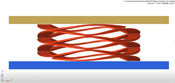
Coiled wave spring (CWS) deformation simulation
As this coiled wave spring (CWS) is a relatively new product on the market, development involves explaining its characteristics and making proposals to many customers. While repeatedly creating prototypes and making proposals during the development phase requires time and cost, the aim of this research is to provide optimal proposals in a shorter timeframe by utilizing simulation technology. Furthermore, since the stress distribution pattern on each part of the coiled wave spring (CWS) can be predicted based on the applied load, the spring life can be estimated more accurately according to the user's operating environment.
We plan to apply this technology to other spring-shaped products, aiming to provide our customers with a wider range of springs with higher precision in a shorter timeframe.
Machinery Division
The connection between research and business divisions
The Machinery Division primarily focuses on pharmaceutical packaging machinery, but also handles the development, manufacturing, and sales of a wide variety of automated packaging machinery for medical devices, food, cosmetics, and daily necessities.
From small machines with a top-notch track record in the industry, suitable for clinical trial drug packaging, prototype testing, and high-mix, low-volume production, to medium and large machines for mass production, we offer a lineup of machines that can meet a variety of needs, and we propose and provide packaging solutions that are tailored to our customers' needs.
In recent years, there has been a growing demand for contributions to society through packaging, such as creating drug shapes that are easy for patients to swallow, using environmentally friendly packaging materials, and designing packaging that minimizes the risk of accidental ingestion. To meet these needs, we aim to promote technological innovation and optimal manufacturing by developing cutting-edge simulation technologies not only in-house but also through industry-academia collaboration with the Graduate School of Engineering Science at Osaka University.
About the research topic
In our Machinery Division, we research development challenges related to pharmaceutical packaging machines. While our daily design work involves realistic drawing using 3D CAD and full use of imagination to visualize the movement of tablets and machinery, our joint research program utilizes simulations to efficiently achieve optimal manufacturing and meet customer needs. Specifically, we conduct research using simulations—made possible through our collaboration with the Graduate School of Engineering Science at Osaka University—to solve problems such as molding simulations for environmentally friendly packaging films and high-performance films with superior moisture resistance, as well as simulations for the supply of tablets and products, which are challenges in packaging machinery. Through this industry-academia collaboration, we receive opinions and suggestions from university professors and researchers, and we believe that viewing machinery from a new perspective can lead to interesting insights and discoveries.
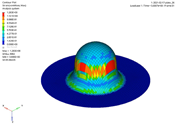
Film molding simulation
Furthermore, in the Machinery Division, we conduct problem evaluations through prototype testing using 3D printers during the conceptualization and initial design phases. The appeal of this company lies in the environment and opportunities to be involved in every aspect of manufacturing, from development through trial and error to the actual production of the machine.
We are conducting research with the aim of becoming a packaging machine manufacturer that can stay ahead of the times and contribute to society, by combining the technical know-how we have accumulated so far with the cutting-edge simulation technology that we will develop in the future.
Medical Device Parts Division
The connection between research and business divisions
Our Medical Device Components Division collaborates with Maruho Co., Ltd. to develop and manufacture minimally invasive medical devices that contribute to improving patients' quality of life (QOL).
Our division leverages the metal processing technology and knowledge of metal materials cultivated through spring development to propose patient-friendly medical devices. One example is our ingrown toenail correction device. This device must be easy for doctors to use and effectively relieve patient pain and correct the nail to a natural shape. We conducted research using finite element simulations to clarify the structural usefulness and efficacy of our ingrown toenail correction device.
To contribute to minimally invasive medicine, we will continue to develop orthodontic appliances and medical devices that will please patients, based on our research findings.
About the research topic
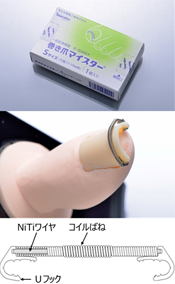
Ingrown Toenail Master®
Currently, the primary method for correcting ingrown toenails is the use of superelastic wires. However, achieving sufficient corrective effects requires the skill and experience of the physician performing the correction, including drilling holes in the nail plate and determining the correct placement of the superelastic wire. The newly developed Ingrown Toenail Meister® attaches to the side edge of the nail with a unique hook, making it relatively easy to use even for physicians with limited treatment experience. Furthermore, this new method of lifting the side edge of the nail with a unique hook is expected to exert a different force on the nail plate compared to conventional superelastic wire correction. Ideally, clinical trials should be conducted to prove its effectiveness to physicians, but this would require a long experimental period before the effects can be communicated.
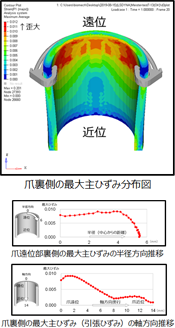
Ingrown Toenail Master® Simulation
This project aims to verify the structural usefulness and efficacy of the Ingrown Toenail Meister® by comparing the mechanical effects that occur on toenails fitted with the Ingrown Toenail Meister® and those fitted with superelastic wire using finite element analysis simulations. The analysis results showed that the Ingrown Toenail Meister® will correct ingrown toenails to a natural shape, that a corrective effect can be expected in the proximal part of the nail, and that it is designed to reduce the risk of nail breakage. We believe that these analysis results will allow us to clearly demonstrate the effectiveness to doctors, accelerate development, and provide better corrective devices to doctors more quickly.
Message from researchers
Hello everyone. I'm Murase, and I'm promoting research themes from each business unit in the joint research program.
This course utilizes mathematical modeling of operating principles and computer simulations to reproduce and elucidate complex mechanical behaviors, thereby supporting the design and development of various devices for Maruho Spring Industry Co., Ltd., including medical devices.
In actual manufacturing, various problems must be solved, not only regarding the final shape of medical devices and the equipment they incorporate, but also regarding manufacturing methods and product quality control. This is where "practical learning" comes in, which can be a starting point for pioneering new research fields, rather than the theories and generalities learned at universities. In this course, you will have the opportunity to interact with graduate students from the Graduate School of Engineering Science and researchers from other fields, and make full use of Osaka University's latest research environment, including state-of-the-art simulation equipment. We warmly welcome young engineers from Maruho Spring Industry Co., Ltd.
Osaka University, Graduate School of Engineering Science, Industry-Academia Collaboration Center
Joint Research Chair in Computational Engineering for Medical Device Development Support
Kohei Murase, Specially Appointed Professor (Full-time)
Because our company alone had limitations in theoretical analysis and simulation capabilities, we have received assistance from Professor Kohei Murase and others in terms of academic approaches. Maruho Spring Industry is responsible for prototyping, evaluation, and manufacturing technology verification, while the university provides support in areas such as theoretical analysis, simulation analysis, and design tool creation. The theme is strengthening the strategic devices of each business unit, and by registering as a visiting member, you can use the university's facilities and systems, and interact with other joint research courses. Let's deepen our interactions not only within the company but also with engineers from the university and other manufacturers, greatly expand our knowledge as engineers, and together create a Maruho Spring Industry that "contributes to a safe and prosperous society with the best products."
Maruho Spring Industry Co., Ltd. R&D Center Representative
